Wednesday, August 18, 2010

Hard Cash HiJack – Looking Beyond SEO, PPC, PPV, Etc.

After launching my Facebook Ads Guide and being a successful product in the clickbank marketplace, I cannot tell you how many requests I have had for email list swaps, paid blog posts, and advertising requests.

But... because I think quality assurance is the most important job of someone who has an email list, my team and I always review every product that is being requested to be advertised. You and I both know that there are a LOT of garbage ebooks, systems, software, etc online these days. In fact, I reject a good 90-95% of the requests for JV list swaps, etc. I hate promoting crap that I don't believe in.

One of the products that I got a request to review was from Mike Auton. Mike has one of the top products in clickbank overall and one of the top in the emarketing section. Naturally, it peeked my interest and I wanted to see what Mike had to offer as far as value and content goes.

Hard Cash Hijack Review


The interesting thing about hard cash hijack is that it's not just an ebook. Although you'd never be able to tell because of the "blind" sales page that basically gives you very little information about that actual product.

Instead HCH is a "system" that includes software and a guide to using it. To my surprise it actually was really interesting and had some good information in this guide.

Sweet, another legit clickbank product besides my Facebook Ads Guide and Coaching Forum.

Without giving anything away (because I'm here to review the product... and not tell you the secrets behind it), the system and software works by helping affiliates to find "unlimited" traffic sources to advertise affiliate offers on at a much higher rate of profit than traditional methods such as PPC and SEO.

Because of that - it has all the great benefits of not running on a search engine or doing seo like no quality score, no website etc.

The other cool thing I like about this ebook / system is that the author, Mike, specifically suggests users to go after big markets. Just like I have said for the last couple years, if you're going to put the effort into trying to tackle 5+ mini markets that can make $100+ per day profit, why not just spend all that effort trying to tackle one bigger market that can make several thousand per day?

I asked Mike how long he has been using this method and software and he has been using it for the last 2+ years. Of course, the software has only gotten better over time and this method does still work (it won't go out of style so to speak).

All in all, I really think that this system has some great information and is one of the better clickbank products on the marketplace right now.

If you're struggling with affiliate marketing, I highly recommend you check it out! Not only does it teach you the complete basics, but it goes over some cool methods + software to help you.

Related Articles

Internet Retailer Rates Top 500 SEO Efforts

The latest Internet Retailer 500 directory is here. Each year this is one of every industry player’s prime sources of data about how the Internet ‘big boys’ are performing and, more importantly, what they are doing to be ranked in these Top 500.

One additional metric added this year to the many that are provided regarding the overall performance of these online e-commerce high flyers, is a category rating SEO effectiveness for the sites. It rates this area using a simple excellent, good, fair and poor system and here are the overall results

While two-thirds of these ‘top’ companies (approximately 330) rate as excellent or good that leaves a lot of elite online players with some work to do.

I would suspect that there are a few copies of this directory being pushed up the food chain in companies by either in-house teams or agency partners to say “See, we are doing a great job, Mr. CEO, even though you have no clue what we are actually doing!” while others are scurrying to keep their bad ratings out of their C-level line of sight.

Conductor helped put together this rating system for the annual publication as MediaPost reports

Conductor helped Internet Retailer create and introduce a new metric, SEO Effectiveness, in which the publisher will evaluate the top 500 retailers. Nathan Safran, who leads Conductor’s research team, created the methodology that determines how effective and well positioned retailers are to succeed in SEO.

Rather than examine how well retailers rank, the methodology looks at how many people in the organization are full or part time and have knowledge of SEO. It turns out companies with senior or C-level execs with knowledge of SEO have a higher chance of being successful by having better positions on Google.

Ok, so wait. Then maybe some C-level execs really do have an idea of how SEO works? Not likely. I would suspect that measuring C-level knowledge of SEO is graded on whether they know what the acronym stands for in the first place then gets less detailed from there. Of course, I am playing here but if someone from Conductor would like to elaborate on just how they measured this knowledge we would love to hear it.

So what if someone were to come in and rate your SEO effort? Where would it land? Are these kinds of ratings valuable or just more data that looks nice rather than helping to move the needle?

Related Articles

Should You Really Enter The “Make Money Online” Niche?

First of all, by “make money online” I mean all the Internet marketing niches, including blogging, social media, SEO, affiliate marketing and so on.

The question I am asking is: should someone who is getting started online enter the Internet marketing niche directly?

Many people seem to think so, judging by the amount of blogs and websites we see popping out in this niche every month.

In my opinion, however, this is a mistake.

Why? Because entering a mainstream niche (e.g., health care, education, finance, travel and so on) can be easier, because there might be less competition there, and more profitable, because the size of the potential audience is much larger. That is why they are called “mainstream” after all, because they appeal to the majority of the population, while Internet marketing has a really small audience in comparison.

Given these facts, why do people insist in entering the Internet marketing niche? I think for one main reason: the Internet marketing community is more vocal about its earnings, strategies and what not, so people get the idea that talking about making money online is the best way to actually make money online.

This is clearly not true.

There are many people out there making a killing in mainstream niches, the only difference is that they don’t blog about how much money they are earning, about the strategies they are using to achieve it and so on.

Now don’t get me wrong. Internet marketing is a profitable niche. I am not arguing otherwise. I am just saying that, in comparison, mainstream niches can be even more profitable.

At this point you might be thinking: “It is easy for you to say Daniel, but you have a blog about blogging and a course about making money online.” This is true, but I also have many other online properties in mainstream niches. Want one example? My other blog, DailyWritingTips.com, was launched after this one, and despite that it receives more traffic and makes more advertising money.

daily writing tips traffic screenshot

Here are the numbers to give you a better idea: DailyBlogTips.com has around 5,000,000 backlinks according to Google, and it generates around 300,000 page views monthly. DailyWritingTips.com, on the other hand, has only 150,000 backlinks according to Google, yet it generates over 500,000 page views monthly (according to Google Analytics. as you can see in the image above).

What is the explanation? It is simple, the “writing tips” niche has less competition and a larger potential audience. Most of my new projects these days are on mainstream niches as well, exactly because I think there is more money to be made there.

The bottom line is: You don’t need to enter the “make money online” niche to have a profitable website. If you learn the Internet marketing principles and apply them to mainstream niches you might end up making more money.


Related Articles

InHouse SEO – BlueGlass LA

We’ve come almost to the end, my friends. With just one site review session after this, you are looking at the last liveblog to come out of BlueGlass LA. Speakers Jessica Bowman, Founder, SEOinhouse.com, Marshall Simmonds, Chief Search Strategist, New York Times Company/About.com, Co-Founder and CEO, Define Search Strategies, and Laura Lippay, Director of Technical Marketing, Yahoo! Media are bringing it on home.

Tony Adam says he’s starstruck and that these are the people he looks up to most when it comes to inhouse. He points out there are three former Yahoos on the panel: Laura, Jessica and himself.

BlueGlass LA Jessica Bowman In-House SEO

Jessica is up first. She’s going to be covering why it’s so hard to get SEO implemented in a large organization. You need efficiency and accountability in order to do it.

You need a healthy organization for good SEO (quoth Gord Hotchkiss).  SEO crosses many disciplines and you end up getting a reputation for sticking your nose into everyone’s business. You need to be part of every team and project.

What is the inhouse SEO Lifecycle? (Follow the link for a free report)

Courtship and Honeymoon: Yep, everyone’s on board, everyone wants you in the meeting, they’re excited. Training happens. Leverage those happy feelings to get changes made. It only lasts 6-9 months.

Reality: But behind the scenes, the programmers are pulling their hair out. Then there’s a project manager who think you’re out of scope. This can last for over two years.

Synergy: Things are good but not perfect.

What happens once you get buy-in? Don’t assume that your battle is done. Buy in is only the first step. You still have to sell the lower level people.

SEO requests: add to man hours, are inconsistent with other goals, go against existing programming standards, weren’t technically feasible, added to the project timeline and cost.

The challenge often is keeping everyone in line with your approach to SEO. They try to run ahead or do end runs around the bots. You need to educate them about best practices and doing things strategically.

SEO needs to be built in and a big part of the development lifecycle. If you don’t, you pay in opportunity cost because you probably haven’t budgeted right. Before delivery is accepted, be sure that SEO has been consulted.

SEO Project Involvement Pyramid

Training and Mentoring is key. Involve SEO in project planning and add SEO to the standards and guidelines of the entire organization.

Contribute to project deliverables. You can get back into honeymoon phase with expert trainers, sending people to conferences, etc.

Really great presentation. I didn’t do it justice.

BlueGlass LA Laura Lippay In-House SEO

Laura Lippay is up next. She’s now with NinebyBlue and no longer with Yahoo. Her presentation is basically her story at Yahoo.

How data, beer and monroe’s motivated sequence got me everywhere: tales of an ex-Yahoo Inhouse SEO.

  • Joined Yahoo January 2006
  • Hired into Business Intelligence team
  • Title: SEO Manager

Her first challenge was getting to know people. So she took people out and bought them beers and got to know them.

She didn’t have good analytics when she first started. Literally, all she had was unique visitors for the whole property. She had to teach herself microstrategy, took excel classes and spent months creating reports. She didn’t really get any SEO done in the first few months.

She didn’t have much buy-in. This is where Monroe’s Motivated Sequence comes in. In a nutshell the sequence is:

  1. Here’s a great thing/opp
  2. Here’s how you’re not reaching it
  3. This is solvable
  4. picture yourself solving it
  5. I can help you.

Next obstacle: It needs to be done in two months.  Solution: Be realistic and honest. Don’t just say yes to impossible tasks.

Obstacle: Educating the masses. Solution: Provide accessible tools, best practices, resources & data. Train (often with beer). Annual internal conferences (beer). Newsletters and reports.

Obstacle: Implementation Solution: Reporting and persuasive data had to be in place first.

At that point, she was promoted and moved over to Marketing, which helped.

They needed to prioritize who to work with first. Did it by opportunity and willingness to work with them as well as if the property was worth it to Yahoo.

Problems with integrating with teams = didn’t fight back, but did report the unwillingness.

Set realistic expectations up front. Provide actions, not recommendations. Make sure to document and report gaps where SEO fell off the roadmaps.

Integrate SEO checks into the QA process.

In 2009, she lost her entire team and had her role completely redefined. This moved her to social media. She started her process over. Beer, persuasion methods, in-person meetings. Check out her slideshare: lauralippay for older presentations.

Tony seconds the use of beer as a motivator as well as newsletters to be in their face. He also suggests that you should reward reading. “Email me the answer to this and the first person who does will get a beer.”

BlueGlass LA Marshall Simmonds In-House SEO

Marshall Simmonds is up. He’s going to tell us what it’s like when SEO stops being nice and starts getting Real. [I would so watch Real World: New York Times. Do they still have the Real World?]

Initial objectives:

  • SEO school
  • Title tags and headlines
  • CMS
  • Images
  • Sitemaps
  • Tracking

Much of it wasn’t feasible. it’s a 10k person.  He doesn’t want to talk to senior management or the people in the trenches. He wants to talk to the people who report to the senior managment. They’re the ones with the budgets. He finds the most success working through the tech team. Without tech buy-in, you’re screwed.

High priority:

  • Sitemaps
  • 301s
  • Template SEO – fixing titles, captions, linking
  • Rel=canonical
  • Rewriting URLs
  • How much it will make/cost/traffic potential (he just makes up a number most of the time “double digit growth”)

Low priority:

  • Page load time/site speed
  • link flow
  • video SEO
  • duplicate content
  • CMS overhaul
  • W3C complicance
  • Education — tech teams won’t come to trainings over and over.

New objectives:

  • Sitemaps
  • SEO school
  • title headlines
  • images
  • url rewrites
  • tracking
  • CMS
  • meta description

How to reach Editors (the most fickle people on the planet)

Best practices are out. They focus on Titles, reach and understanding, top two keywords, copy and pasting, wysiwyg, repetition

Low priority: Best practices, headlines, wikis, keyword research — eventually

They don’t spend a lot of time trying to get them to understand tools and trends. They’re equipped to write the content. They don’t use webmaster central. It’s buggy, it doesn’t scale around the 20-50k page mark. Backfill webtrends and omniture with Google analytics.

Tools:

  • gsitecrawler for server check
  • xenu for links
  • seomoz in general
  • seochat for spider simulator

Get a budget and build a tool inhouse if you have to.

Related Articles

Google Now Displays Complete Backlink Data For Your Website

There is a big change in the Google Webmaster Tools. Historically Google only showed a sample of your backlinks (i.e., 10% or less), so webmasters had no way to know how many backlinks their websites had according to Google.

People argued that this was a measure to prevent people from trying to reverse engineer Google’s search algorithm.

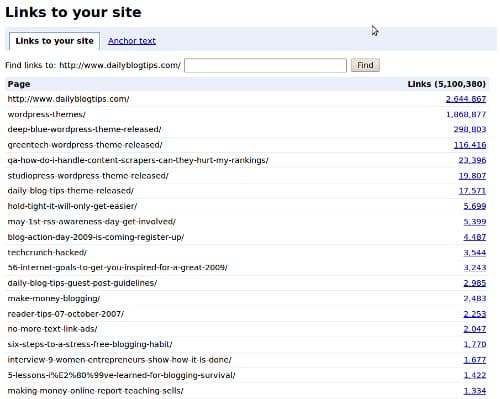
I was reading Search Engine Journal yesterday, however, and I discovered that Google just changed this feature. If you log into your Webmaster Tools account now, under the “Site Analysis” and “Links to your site” section you’ll find the complete backlink data for your website.

google-webmaster-backlinks

I remember that before this change Google was reporting around 500,000 backlinks for DailyBlogTips.com, and now it reports over 5 million (as you can see in the screenshot above). You can also see which pages are getting more links, and even export the whole thing as a spreadsheet.

I think this is an important change for two reasons. First of all it will help webmasters understand where their backlinks are coming from, and how they affect the search rankings of each page. Secondly, this change also signs that Google is becoming more transparent regarding how it indexes and crawls the web.

Related Articles

5 Blogging Activities Perfect for Summer

For many blogs, summer is the slow season. People are on vacation, schools are out, dorms are empty and most sites see a noticeable drop in traffic until the cooler weather comes.

So what is a blogger to do with this time? Even if one’s site isn’t outright dead or quiet, it’s often much less active and that can create a case of summer blues, where bloggers feel as if they’re putting in the hours but not seeing the results they expected.

However, there’s good news. The slower months are an excellent time to do some very valuable work on your site. Some of it is to gear up for when things ramp up later, others exploit the reduction in competition to have a more immediate impact.

Here are five things you can use your summer doldrums for to make your site that much better.

1. Change/Improve Your Theme

Since traffic is less, you can relax a bit on your posting schedule, either removing a posting or two per week or shortening what you write daily, and put that time back into your site by improving your theme.

With the release of WordPress 3.0, there’s a lot of great ways you can upgrade your theme, not to mention new themes you can change to.

Simply put, more time and fewer visitors makes summer a great chance to make these changes and make sure they’re done right. It is certainly better to have some downtime or make a blunder now than in peak season in a few months.

2. Do Some Link Building

This means two things. First, reach out to other bloggers and see about swapping links when practical. Second, write some high-quality linkbait posts and push them out over social media channels in a bid to draw others to link to you.

During summer months, though there is fewer people online, there is also less competition for those eyeballs. This is an excellent chance to get some inbound links to help your SEO and build new roads to your site for when the masses return.

3. Get Social

Summer is a great time to either gets started or get more involved in social networking. Since people often continue to tweet, check Facebook and manage other social profiles even when away from a computer, largely because these activities are mobile-friendly, those activities don’t drop quite as much during the summer months.

Take advantage of this and start working on your Twitter following, make some new friends on Facebook and so forth. Get out there and grow your social media/social news presence.

It will not only help grow your audience for your posts in the summer, but help you accelerate growth after the slow season ends.

4. Try Out New Ideas

Got a new idea for a column but aren’t sure if it will take off? What about a new video series you’ve been wanting to try? Now is the perfect time to try it out. The people still at your site are, for the most part, your core audience. Now is the chance to try out new ideas on them without worrying about what newcomers will think.

Though it might seem risky trying out things your core readers, remember that they are the ones who are most likely to give you honest feedback and not knee-jerk reactions. Experimenting now lets you maximize the amount of feedback you get from dedicated readers while keeping the new voices to a minimum.

5. Upgrade Your Site or Move Hosts

Finally, if you need to upgrade to the latest version of your blogging platform, switch to another system or change hosts, now is your chance. A few days of site downtime or erratic behavior will matter less now than in a couple of months.

If you have any upgrades or updates that you’ve been putting off for fear of breaking your site, now is a good time to make your backup and give it a go, especially if you do it during the slower part of the day and week.

In short, you’re never going to find a time with a smaller audience, the risk is as low as possible.

Bottom Line

The summer months can be a depressing time for bloggers but they don’t have to be, it can be the most productive time of the year and represents a chance both to grow your site and prepare for busier times.

However, don’t forget to carve a little bit of rest and relaxation time in for yourself too. After all, pushing yourself too hard at any time can result in burn out and that can be more dangerous to your blog than just about anything else.

Use this time wisely but don’t get too caught up. Your site and your mind will thank you.

Related Articles

Tuesday, August 17, 2010

Web Usage Guessing Game — SEM Synergy Extras

Today’s episode of SEM Synergy, our weekly Internet marketing podcast / industry lovefest, was a blast. As usual.

Quick highlights? Guest Steve Plunkett illustrates Foursquare gripes care of Hooters. Jessica makes her show debut. And Susan predicts the whole Internet thing is a passing fad. :D [SEO is dead! Newspapers are the way of the future! —Susan] Care to tune in?

Oh. You’re not easily seduced by non sequitur teasers and orange hot pants? Wow. Tough crowd, but you’re right. I owe you more than that. I owe you some nitty gritty. It’s time to get a dirty in Web data.

Web Usage Shifts

Bruce, Susan and I started the show discussing Web usage trends. Internet users are now spending around 22 percent of their online time on social networks. Online video viewing has reached an all-time high. And time spent online is rising and falling, depending on what metric you’re looking at.

Regarding the last point, I’ve pulled together some data from Nielsen Company on the average Internet usage in the U.S. for January, February, March, April and May of 2010.

Examining the Evidence

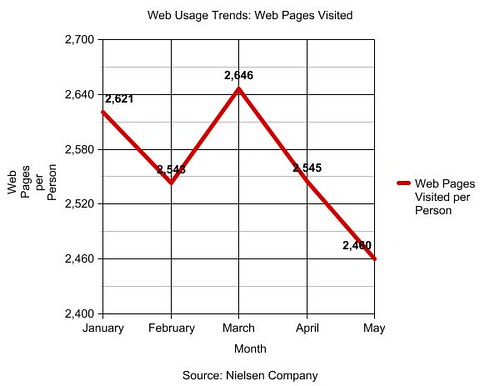
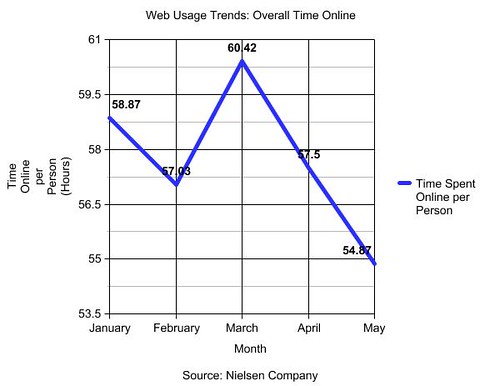
Here are charts I created to visualize the data. (Note: If you compare the Nielsen reports linked to above to the data on the chart, you may find inconsistencies. There were occasions where the figure reported for a month was different in the following month’s “previous month” column. In these cases, I opted to use the following month’s “previous month” data with the logic that numbers may have been refined as more data is made available.)

sessions online
domains visited
web pages visited
time spent online overall

So basically, people are firing up a Web browser a little more than they did at the beginning of the year; the number of different sites a user visits in a month seems to be fluctuating; the number of individual pages a user visits in a month is dropping, and so is the overall amount of time spent online.

Now take a look at those last two graphs. I’m no scientist, but is there some kind of correlation between the fewer numbers pages visited and the lessening amount of time spent online? This brings up a chicken-or-the-egg problem: are people A) spending less time online because they’re visiting fewer pages, or B) visiting fewer pages because they’re spending less time online? To narrow down these options, I considered the first and second graphs. People are hopping online more often now than in January. At the same time, the number of different sites they’re visiting is all over the board. With these additional pieces of info, I’m leaning toward hypothesis A. People are going online more, visiting more or less the same number of sites, and yet they’re not visiting as many pages, leading to a decrease in overall time spent. So why the fewer number of pages visited?

Theories Off the Top of My Head

Less Searching: There’s no question that Internet users are becoming increasingly savvy. So it stands to reason that they may be doing fewer searches as they’re better at finding what they’re looking for. This could be because:

  • Their queries start out more targeted so they do fewer refining searches.
  • They’re better at recognizing the most relevant result in the SERP.
  • They’re less likely to use the search bar as navigation.
  • Search engines are continuing to improve the relevance of results with blended search and personalization.

On the other side of the coin, as sites become more optimized and evolved, the number of searches performed may decline. This could be because:

  • The results displayed in SERPs may be more likely to satisfy a searcher’s need.
  • The answer is displayed in the SERP itself, either called out by the engine or in a result page’s description.
  • Fewer searches are required thanks to Sitelinks.
  • Social media is answering questions before a search is needed.

Mobile Surfing: I’m not experienced in Web analytics, but does time spent in a mobile app get counted in Web usage data? Like, when I’m using the LA Times shiny new iPhone app, is that time being counted by the folks at Nielsen? If I’m reading my news feed on Facebook’s app, can Compete.com see that?

Furthermore, when I’m using a Twitter app on my smartphone, I’m following links and bouncing around to lots of different domains, but I’m not digging into the site or viewing multiple site pages. Actually, my behavior on my phone looks a whole lot like those four graphs above. Overall, I’m going online more than ever because the Internet is in my pocket. However, my sessions are shorter and my visits to sites are bouncier — I’m just visiting one page, usually through a link on Facebook or Twitter, and then leaving.

Of course, no one really knows what’s at the bottom of the Web usage mystery, so why not make a game of it? It’ll be like Clue! I’ll start. I suspect adult Internet users visiting links from Twitter with mobile phones. Your turn!

Related Articles

Webspam projects in 2010?

About a year and a half ago, I asked for suggestions for webspam projects for 2009. The feedback that we got was extremely helpful. It’s almost exactly the middle of 2010, so it seemed like a good time to ask again: what projects do you think webspam should work on in 2010 and beyond?

Here’s the instructions from an earlier post:

Based on your experiences, close your eyes and think about what area(s) you wish Google would work on. You probably want to think about it for a while without viewing other people’s comments, and I’m not going to mention any specific area that would bias you; I want people to independently consider what they think Google should work on to decrease webspam in the next six months to a year.

Once you’ve come up with the idea(s) that you think are most pressing, please add a constructive comment. I don’t want individual sites called out or much discussion; just chime in once with what you’d like to see Google work on in webspam.

Add your suggestion below, and thanks!

Related Articles

With Facebook Open Graph Search, Is Facebook SEO Next?

It seems to be clearer than ever that Facebook is really making a run at Google around search. The announcement that “all Open Graph enabled web pages will show up in search when a user likes them” this new area for search abuse optimization is now becoming a reality.

All Facebook reports

Earlier this week we published about the new Facebook SEO that’s possible via the Open Graph, but now it’s clear that this is the beginning of Facebook’s internet search strategy. The race is now on for publishers to optimize their sites for Facebook’s search engine.

I can’t decide if this is a good or bad thing. I just don’t see how Facebook and bing are going to be a formidable opponent to Google. The trouble lies in the fact that anything that is based on end users opinions is ripe for abuse and manipulation. In order for search to be truly helpful in a broad stroke manner I believe that there needs to be as much objectivity in the results set as possible. Objectivity opens up more options to searchers because it allows for a wider scope of results to be considered by the engines themselves, not just the musings of the general public that, quite honestly, is just trying to be cool rather than helpful.

All Facebook continues

Under this system “link baiting” will give rise to “like baiting”, which is how Facebook determines the relevance of information. This has become a full-scale attack on Google on all fronts at this point as Facebook has officially entered the internet search market. While many of the details of the Open Graph were initially revealed at f8, it wasn’t clear what Facebook’s complete strategy would be and how big of a threat this would be to Google.

While we suggested that the like had just replaced the link, it has now become abundantly clear what Facebook’s intentions are. Facebook wants to launch the social semantic search engine as we alluded to during f8. Now that the search results are officially showing up as Facebook search results, the war has begun.

I think that before full scale war is declared you will need to see just how serious a contender Facebook will be for search. A few questions I have include: Just how many of the 500 million users Facebook claims are actual users of the service? That is important because the actual number of people that involved in the “system” of the Open Graph (those who understand what a Like button is) may create a skewed view of the world from a search perspective. If the Like button is the major determining factor of a search result showing up, I feel that is a very weak criteria for basing rankings in search.

I am really looking for opposing views here to explain how this really is a challenge to Google. I personally would never value a Facebook search result page that is based on the OpenGraph and bing results, over a Google result set. It just seems like a mash-up of two inferior ways to tell people what is important or relevant. Also, the room for this to be abused is just too great. Lastly, if Facebook handles search like it handles privacy this could be a gigantic train wreck in waiting.

Would love to hear opinions on this one. Have a great weekend.

Related Articles

Control-Freak Execs and Online Marketing

”Are You a Puppet on a String?”  height=
CC BY 2.0

This week, I saw several posts on Search Engine Journal’s weekly news recap with people talking ownership of their trade, how each facet of online marketing is truly a craft and really, the need for experts.

This got me thinking about that age-old issue of business owners and execs believing that just because they run successful companies, they have the expertise to make critical decisions as it relates to online marketing. Funny thing is, we’re still talking about it … after all these years.

To Whom It May Concern:


I see that you have a college degree and several credentials mounted on your wall. And they actually have nothing to do with marketing, copywriting, SEO or any of the like. So please stop trying to run the show.

Sincerely,

The Expert

Eh, maybe they didn’t get the memo. But there’s a strange phenomenon happening all over the U.S.: Countless business owners are actually hiring experts in their craft to improve their company’s online presence. Crazy, right?

Except instead of trusting their expertise, everyone involved becomes part of a weird control freak show, where the experts are only allowed to contribute as much as the boss will let them.

One of my favorite comics by The Oatmeal is How a Web Design Goes Straight to Hell. It really sums up the twisted relationship that can happen sometimes between company and expert. So, how do we, as experts, get past this endless push and pull?

This past week, Bruce Clay hosted a webinar on Search Marketing Now that talked about SEO in large organizations, managing expectations and tactics for successful implementation. One point he made loud and clear is that education is key when receiving buy in. This includes educating the decision makers to make sure people understand the process so they can support it.

At Bruce Clay, Inc., it’s in our contracts that clients attend our SEO training so they can understand everything that goes into what we do here, because we’re committed to knowledge transfer. It not only gives them a good grasp of the craft of online marketing, but also allows communication of the strategy to become more fluent during the span of the working relationship.

In the webinar, Bruce also talked proving the benefits of an SEO strategy. It’s been my experience that if you can show how the strategy can affect the bottom line, you’re more likely to get what you want (aka, what’s best for the company) – but it’s not always easy to define success with things like Web design and copywriting. And seems like it’s even harder to prove you actually want the company to succeed, which is why they hired you in the first place and why you’re making the suggestions you’re making. So, what gives?

Our SEM Synergy podcast earlier this month invited a couple specialists here at Bruce Clay, Robert Esparza and Alan Lamb (see Robert catch Saturday night fever here), to talk challenges of selling an SEO project that meets the client’s goals and needs.

Alan and Robert speak on behalf of the vendor versus the in-house expert, and say if you have the luxury, assess the project and the client’s expectations prior to taking the business on, so you know it’s something that’s set up for success in the long run. Ask yourself, Are the client’s expectations feasible? If not, be honest with yourself and the client, taking care not to sacrifice your recommendations at the cost of being amicable.

A recent post by Robin Fox on the HubSpot blog talks 10 steps to get CEO approval for online marketing. She makes some really great points on how to communicate to the decision makers, regardless of the recommendation:

  • Study the decision makers like customers to find out what makes them tick.
  • Focus on the benefits not features.
  • Speak their language. Literally. Then make concepts visual not just language-based.
  • Find the right person in the organization to deliver the message.

Sometimes these concepts work, and sometimes you can talk until you’re blue in the face and still, your decision maker might just go with his or her opinion. And so the story goes …

So it seems like all we can do is exchange our secret weapons on how to conquer the anal retentiveness that is the control-freak executive. I want to know, how do you assert your expertise either within your organization or as a vendor working with client companies? Chime in and tell us about it.

Related Articles

Outside the Bot: Blended Search Strategy — SEM Synergy Extras

I can always count on Twitter for something to tickle my fancy. Yesterday @kennyhyder put a smile on my face by sharing a video that satisfies my infatuation with robots and getting jiggy with it:


dog with 10 commandments
This pup takes commands very seriously!
CC BY 2.0

I think we can all agree that robots are the coolest. Now that I think about it, I think they’re likeable for a lot the same reasons as puppies. They’re smart, but a little bit dumb, in an endearing kind of way. They’re super cute, which is nifty considering you can almost see yourself in them. And they exist to do your bidding — sit, do a jig, pour me a drink. What? Your dog can’t do that? It’s time to learn some new tricks, pooch! ;) [The big difference is you can't cuddle robots. If they ever make a cuddly robot, I'm doomed. —Susan]

But seriously, robots are awesome and all, but there’s a reason it’s called “artificial” intelligence. Certainly we rely on technology; not only does our industry optimize the land brought to us via wires and tubes, but we also use technological tools to get these jobs done. But with our heads down in tech-ware, both hard and soft, we may sometimes need a reminder to come up for air. Take a breather with me and consider an area of search where chips and codes are no replacement for squishy gray matter.

SERP-Specific Evaluations for Blended Search Strategy

Today’s SEM Synergy features an eye-opening interview with the SEO Dojo’s David Harry. Dave explains the pressing need for a blended search strategy as Universal Search results are now displayed for 25 percent of Google search queries. That means a quarter of the time, SEOs are missing out on SERP real estate if blogs, videos, images, news, social and other blended search categories aren’t considered.

Dave suggests a “SERP-out” approach for developing a blended search strategy:

Just like we’ve always looked at the page when we had the ten links, now we’ve got so many more things. […] Instead of looking at your tool that’s telling you my rankings are here and I’m ranked sixth and whatever, if you’re not actually visiting the search result page and looking at the make-up of it, the actual real estate — [for instance,] there’s a big 10-box of e-comm here — well, your six is so far below the fold that it’s really lost value.

And you could be sitting in third place and if something of a blended or Universal pops up then once again it’s pushing your third place ranking down to fourth — well, [the tool] still says third but you’re still below the fold so you’ve lost it. So [for a SERP-out approach] you’re looking at the actual SERP, looking at the real estate, where it’s being assigned and how they’re doing it.

Tools and technology are of course the meat and potatoes of the business we’re in, but as SEOs we’re offering our clients more than that. We’re offering the brain power that can visualize a strategy that works in a specific SERP environment as well as the ability to execute it and power some necessary tools to simplify the process along the way.

In fact, just when you thought it wasn’t possible, it turns out we’re even cooler than robots!


Related Articles

When the Game Changes, Change With It

The new Jabulani soccer ball being used all month during the World Cup is meant to be faster, more accurate and more reliable. But even such noble qualities didn’t help the change find acceptance with those playing the game.

In an interview, Italy striker Giampaolo Pazzini said:

“It moves so much and makes it difficult to control. You jump up to head a cross and suddenly the ball will move and you miss it. It is especially bad for the goalkeepers if it means they concede a goal because they can’t judge the trajectory.”

A football striker wearing the number 10 shirt...
Image via Wikipedia

Sound familiar?

SEOs are accustomed to the task of aiming at a moving target. Changes to the ranking algorithm and search engine guidelines come fast and furious, with the intention of bringing a faster, more relevant experience to the end user. Adding to the complex challenge of online marketing are shifting user preferences, emerging technologies and the conventions of newly sprouted social watering holes.

This week Adam Audette gave us a thoughtful and tactically driven analysis of today’s search marketing landscape, offered in the midst of industry growing pains instigated by what is perhaps the largest tectonic shift the industry has yet seen. Consider the critical mass of Internet and social media users, the spiking adoption of mobile and tablet computing devices, and even the effects of the new Caffeine indexing infrastructure. A Turning Point in the Field of SEO may help refresh and reframe your current priorities in interactive online marketing in the face of the next Internet marketing era. Clearly the rules have changed since the first players made a dash to the top more than a decade ago.

And the rules continue to change. For a view of what could be the future of online interaction, check out Bruce’s tell-all predictions, shared with WebProNews at SMX Advanced Seattle.

Some highlights from the interview:

  • Optimization is not just about search engines, either paid or organic, as SEOs have known for some time. Optimization applies to analytics, usability, site architecture and social media presence.
  • Traffic past the first three results will have such a pronounced drop-off that the goal of SEO will shift from first-page status to top-three results status. The top three results are the new first page.
  • There will be a distinction between “search” and “find”. “Search” will be about research while “find” will refer to the user’s desire to go to a specified online location.
  • The application experience will become the new Web as mobile devices boom. However, developers won’t be creating applications for every website. Rather, the OS will become the new browser, communicating directly with websites which will deliver the data through an application shell experience.

Watch the video yourself for all the above and more to start conditioning your skills for the new game.

Related Articles

Monday, August 16, 2010

Friday Recap: Space Cadets Edition

Lots of important things to share with you today. Better get to it!

Last week Susan asked that people get on the Robert bandwagon for So You Think You Can Dance. Yes, Robert had another stellar performance on this week’s show, but one friend had bigger aspirations — hopes of seeing BCI’s Robert Esparza getting jiggy wit’ it. And who are we to disappoint? I bring you Robert and Gary Luke’s disco boogie!


Personalize funny videos and birthday eCards at JibJab!

That’s not the only gift we’ll give the Internet marketing community this month. On July 2 we’ll announce the winners of the Small Biz Discovery Contest. Make your choice for the grand prize winner known by voting for your favorite article in the SEO and social media categories. We adjusted the voting process this week, which means voting is open until the end of June. And when you vote, you can enter a drawing to win a seat in our SEOToolSet Training. Make someone’s day and learn along the way.

The situation in the Gulf Coast continues to be a story of hardship and sadness as Americans consider ways to help the disaster relief effort. There’s one very easy way to pitch in if you’re a Twitter user. Just retweet the following Twitter update by Stephen Colbert: “in honor of oil-soaked birds, ‘tweets’ are now ‘gurgles. http://bit.ly/cIhZNf“. For every tweet, Comedy Central will donate $1 to the Address the Mess Campaign, up to $50,000.

The oil spill is probably the least cool thing that can be seen from space (understatement), but wouldn’t it be fantastic to check out that view? Sure, space travel is terribly expensive, but now there’s a way that you can send your face to space, which is actually pretty sweet. NASA’s Face in Space program will launch your likeness into celestial orbit and all you have to do is upload your image. Just don’t blame me if you’re the first to be hunted down by the aliens when they show up. (I totally stole that joke from Susan’s friend. Respect.) [Who cares? It’s your FACE! In SPACE! I for one welcome the alien hit squad. —Susan]

While we’re still finding puzzles out in the final frontier, it’s possible to get a better understating of the next frontier of the Web by reading Why You Should Adopt HTML5 — Now.

YouTube has adopted a cloud-based video editor, which will be handy for basic editing needs. I’m hoping to get in some video interviews while at next month’s BlueGlass LA conference, so I plan to give the video editor a whirl then. By the way, you can get a 15 percent discount on a conference pass with our code bcbgla. Susan and I will be there, and I think you’ll want to be, too.

AOL dumped Bebo, the social network the online network acquired in 2008 for about $850 million. Reports pegged the sale at $10 million, with AOL throwing in an arm and a leg to sweeten the deal.

This feature’s been missing for a while, but I learned some really spiffy things from Boing Boing this week!

And for our final story of the day, it seems that Lakers fans aren’t done causing trouble. A cake celebrating the NBA champions caused a stir when some in the office wanted a pic on the blog and others (coughSUSANcough) refused. I was in the mood for a little mutiny so I took the picture and am posting here. We’ll see if Susan can stand it enough to let this one slide through to the blog… [I said no! Boo, Lakers! —Susan] Mmm… insubordination tastes like chocolate. —Virginia

Happy Father’s Day weekend, everyone!

Related Articles

June’s SEO Newsletter Hitting Presses Now — Your Sneak Preview

I just got a peek at this month’s SEO Newsletter and I couldn’t help but try to land the scoop. This one’s got something for everyone — chunky tactics for implementing SEO in large organization environments; juicy results of research done by the Bruce Clay Australia team; and just the meatiest bits of SMX Advanced Seattle coverage. Though as LeVar Burton would say, you don’t have to take my word for it. Check out some snippets I swiped below, or subscribe to the SEO Newsletter (just over yonder in the blog sidebar) to get the full package delivered to you first thing tomorrow.

FEATURE: Takeaways from SMX Advanced Seattle 2010

smx advanced seattle 2010 logo

At SMX Advanced Seattle, Bruce Clay, Inc. and the team of guest livebloggers reported the information and research shared at 14 sessions. Topics and tactics ranged from SEO and social media to paid search and business considerations, explained by Internet marketing professionals and search engine representatives. Here you’ll find selected highlights from each of the 14 sessions. You can find in-depth conference coverage in the SMX Advanced liveblog posts on the Bruce Clay, Inc. blog.

BACK TO BASICS: Tactics for Successful Implementation

This article is intended to serve as a follow up to a live webcast presentation for Search Marketing Now. You can view the recorded webcast and read about the strategy of managing expectations and defining success for SEO in large organizations for background on the tactics offered here.

In part one of this two-part series on SEO for large businesses, we outlined 12 key areas where large organizations must focus their search engine marketing initiatives and four tactics which help accomplish these high-level strategies. In part two, you’ll find specific tasks that can help accomplish the goal of the key areas.

INTERNATIONAL: Universal Search Occurrences and Types in Google.com.au

Recently, we noticed many more Universal Search results appearing in the Google.com.au SERPs. We performed some testing on the number of occurrences and the type of Universal Search results to provide some actionable insights and data to back up our observations.

percent of universal search results in SERPs

In addition, we wanted to test what Marissa Mayer, the Google VP of Search Products & User Experience stated in November 2009. In the interview, she noted that when Universal Search launched in 2007 a Universal Search item appeared in 4 percent of search queries, whereas in November 2009 a Universal Search item appeared in 25 percent of search queries.

We selected a sample of different search results in Google.com.au (searched from an Australian IP and eliminating the impacts of personalised search) and recorded the occurrences and types of Universal Search results. We gathered this data across a number of different keyword groups including brand, high-volume, mid-tier, long-tail and celebrity- and news-related keywords. We then tracked those search results over a period of days to determine the level of change.

Related Articles

Give Buzz another look

Have you given Buzz a try recently? Robert Scoble just asked if it was time to reconsider Buzz. Coincidentally I said almost the same thing in a question and answer session with Danny Sullivan last week at the SMX Advanced search conference.

I’ll repeat what I said last week. Do you remember when you first started on Twitter, and you didn’t know quite what to do with it? Who do I follow? What do I say? I didn’t really “get” Twitter for months. But as I found interesting people to follow and got the hang of it, I began to see the appeal of Twitter and started using it more often. I’ve noticed Buzz is tracing that same trajectory for me: an initial burst, followed by a bit of a slump, and then a steady climb as I found people that make Buzz interesting.

Buzz fits nicely between tweeting and blogging. Twitter is perfect when you want to share a link or a single crystalized idea. But Twitter isn’t as strong for group discussion or expressing medium- to long-form ideas. At the same time, blogging is great when you want a permalinked url that will stand the test of time, but it can be a real pain to write a blog post. I always feel like I have to polish my blog posts and it seems to take me at least an hour to write a blog post no matter what I say.

Buzz has the casual feel of Twitter, but you can dive into a topic pretty deeply. Buzz is easier than a blog post, but can look almost as polished. I find Buzz especially good for asking opinions, because the signal-to-noise ratio is (at least right now) quite high. I think Buzz is incredibly strong for internal company discussions too, so I’m looking forward to Buzz rolling into Google Apps.

If you haven’t checked out Buzz, or haven’t checked it out recently, you might want to give Buzz another look. You can follow me on Buzz if you’re interested; we’re having a nice discussion about favorite Chrome extensions right now.

Related Articles

Friday Recap: Special World Edition

Wow! What a week! SMX Advanced was intense. I learned a lot and made deeper personal relationships, and I wasn’t even there! It’s all thanks to the incredible liveblogging that I was honored to take part in. You can too — just head over to the earlier posts from this week (I’ve rounded them all up here and we share some additional liveblogging lessons here) by Susan and special guests Alan Bleiweiss, Dana Lookadoo, and Gil Reich.

Those who attended Bruce’s SEO training workshop yesterday found it to be a strong way to close out the show. Exhibit A was one attendee’s Twitter sentiment, which Paula shared in the writers’ room chat. I’ll let you into our special world for a moment:

[10:50:38 AM] BCI-Paula Allen: http://twitter.com/samturri/status/15866347656
[11:01:12 AM] BCI-Virginia Nussey: yay! super tweet!
[3:54:49 PM] BCI-Virginia Nussey: http://www.theawl.com/2010/06/new-york-times-bans-the-word-tweet
[3:56:24 PM] BCI-Virginia Nussey: so my above message would read, “yay! super Twitter update!”
[3:57:11 PM] BCI-Paula Allen: Excellent Skype reply!
[3:57:51 PM] BCI-Susan Esparza: What do they do when they’re talking about the interface? “Then you press the Twitter update button”?
[3:58:26 PM] BCI-Susan Esparza: Then people will be “What’s the Twitter update button? I don’t see the Twitter update button.”
[3:58:31 PM] BCI-Susan Esparza: “How will I study?”
[3:58:49 PM] BCI-Paula Allen: You’ll read the NYT, naturally.
[3:59:23 PM] BCI-Paula Allen: Ooo, now I want to write “tweet” and “tuchus” in the same sentence!
[4:00:12 PM] BCI-Paula Allen: And what’s the “invented past-tense”? Would I have had seen it?
[4:00:32 PM] BCI-Susan Esparza: Look, in Real Media Establishments like the NYT, they do not sit on their tuchus and tweet all day long.

Man, we crack ourselves up!

Google announced that its souped up indexing infrastructure, Caffeine, was fully live. People were less impressed by a Google experiment meant to highlight the new ability for users to personalize the home page with an image. [Dear Google, just be Google. You don't have to be Bing. —Susan]

This week we also saw the official unveiling of Apple’s iPhone 4, iOS 4, Safari 5 browser and iAd mobile ad program — am I missing anything. They’re very busy people over there.

BlueGlass Internet marketing conference logo

A new Internet marketing conference was announced last week, hosted by the teams at Search & Social and 10e20. Search & Social publication Search Engine Journal held a contest this week with the winner receiving a pass and hotel room for the conference, BlueGlass LA, taking place July 19 and 20 in beautiful Marina Del Rey. The contest asked people to post a Twitter update on what outrageous thing they’d do for the prize. Let’s just say the winner’s a brave soul.

That contest was further proof that engagement’s the big goal in all this Internet marketing stuff we do. To generate some engagement on your Internet marketing site, there’s now an easy way to create a white label keyword tool widget that you can put anywhere: the Widget Generator. Thanks, WordStream!

Both Yahoo! and Bing announced big moves in the social space this week. Yahoo! announced an agreement with Facebook to share content from the social network on Yahoo! platforms. Bing announced their new social search vertical, which will aggregate updates from Twitter and Facebook and highlight trending real-time data from these services.

If you’re not in South Africa right now but are hyped for the World Cup, which kicked off today, there’s a rundown of all the ways you can make the most out of the media, including websites, mobile apps and radio/podcast coverage. And if you’re not interested in the sport itself, your inner scientist may be interested to know that there’s quite a controversy going on about the fancy new soccer ball that’s being used. The new ball is almost perfectly round, uses wind channeling technology and has a more friction-y texture. It appears to twist and turn unexpectedly mid-flight.

And finally, the most important news of the week — drum roll please…The competition stage of “So You Think You Can Dance” has just begun and Susan wants you on Team Robert. [He's a hometown boy and my massage therapist's son! Plus he has cute floppy hair! What's not to love? —Susan] Aren’t you glad you stopped by today? :)

Related Articles